






How Often to Reapply Sunscreen: The Expert Guide to Radiant Protection
 What if your diligent morning application of SPF is offering almost no protection by the time you step out for your lunchtime coffee? It’s a frustrating thought, isn't it? You’ve invested in a beautiful, high-quality sunscreen, yet the fear of premature aging, a ruined makeup look, or that greasy feeling from multiple layers can make all-day protection feel like an impossible task. We understand the desire for a flawless, effortless routine that truly works.
This is why we've created your expert guide to mastering sun care. We will move beyond generic advice to give you a clear, bespoke schedule, answering precisely how often to reapply sunscreen for your unique lifestyle. You will discover elegant techniques to layer protection over makeup without a trace of stickiness and finally understand the science of how UV rays affect your skin, even through a window. Prepare to transform your approach, ensuring your complexion remains radiant, rejuvenated, and impeccably protected from dawn until dusk.
Key Takeaways
- Discover how often to reapply sunscreen with a tailored approach that considers your unique lifestyle and the daily UV Index, not just a generic rule.
- Master the professional technique for reapplying SPF over makeup to maintain a flawless finish without smudging or pilling your foundation.
- Understand the truth behind high SPF ratings and why relying solely on the SPF in your cosmetics may not offer the complete protection your skin deserves.
- Learn how to elevate your defence against urban pollutants and environmental stressors for a truly radiant and rejuvenated complexion.
The Science of SPF Degradation: Why Reapplication is Essential
You meticulously apply your broad-spectrum SPF 50 each morning, creating a perfect shield for the day ahead. But is that single application truly enough to protect your skin's wellness and radiance until evening? The simple, science-backed answer is no. The effectiveness of your sunscreen begins to diminish from the moment you step outside, a process known as SPF degradation.
This degradation isn't a flaw in your product; it's the natural result of your sunscreen doing its job. To understand why, it helps to know that sunscreens work in one of two ways. Chemical filters (like avobenzone and octocrylene) function by absorbing UV radiation and converting it into a small amount of heat. In contrast, mineral filters (zinc oxide and titanium dioxide) form a physical barrier that reflects and scatters UV rays away from your skin. For a deeper dive into the chemistry, The Science of Sunscreen provides an excellent overview of how these filters function. Both types, however, are susceptible to breaking down over time.
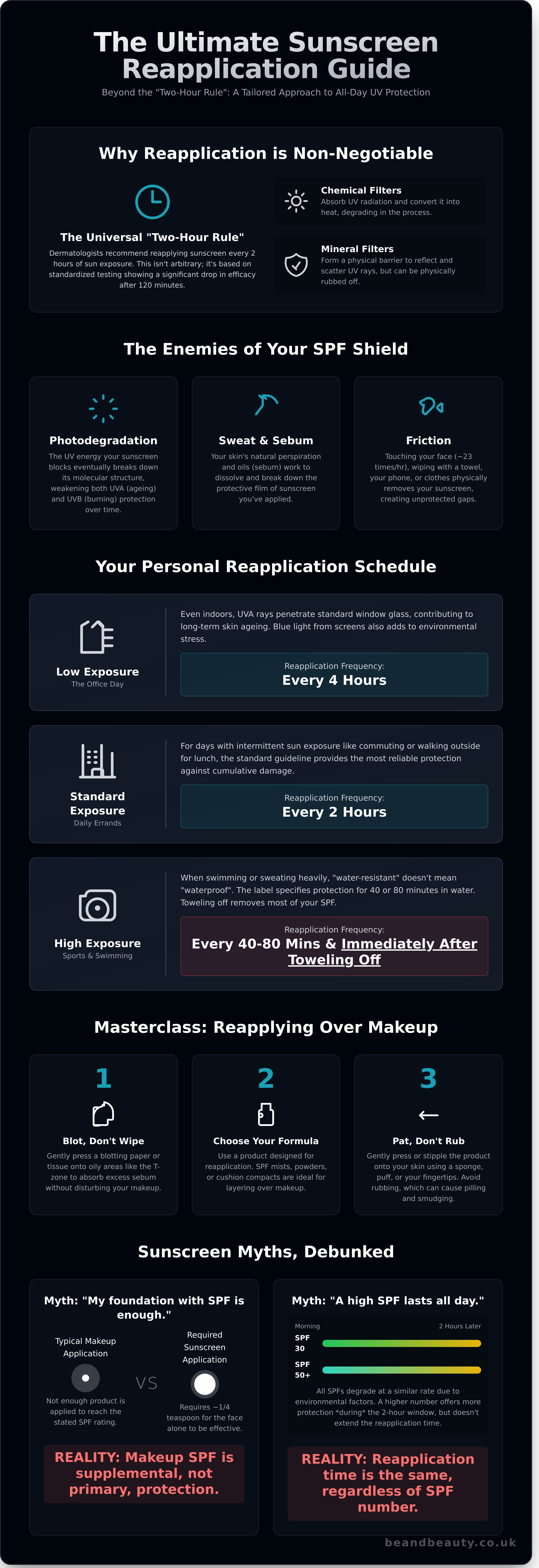
This leads us to the universally accepted "two-hour rule." This guideline, recommended by dermatologists and regulatory bodies globally, isn't arbitrary. It’s based on the standardised testing used to determine a product's SPF rating, which shows a significant drop in efficacy after 120 minutes of typical exposure. Your skin’s own natural oils (sebum) and perspiration also play a crucial role, as they work to dissolve and lift the protective film you so carefully applied, leaving your skin vulnerable long before you might feel a burn.
Photodegradation: What Happens to Your SPF Under the Sun?
Imagine your sunscreen as a diligent team of workers. As UV rays hit your skin, the chemical filters absorb that energy, but they can only handle so much before they become exhausted. Photodegradation is the process where the very UV energy your sunscreen is designed to block eventually breaks down its molecular structure. This means that with continued sun exposure, both your UVA (ageing) and UVB (burning) protection begins to wane, compromising your defence against everything from fine lines to sun damage.
The Friction Factor: Beyond the UV Timer
The question of how often to reapply sunscreen isn't just about UV exposure. Your daily activities physically remove the product from your skin. Simple, unconscious habits like touching your face (which studies show we do around 23 times per hour), answering your phone, or adjusting a face mask can wipe away your protection. Even a formula labelled "water-resistant" isn't invincible; this term simply means it maintains at least 50% of its SPF after 40 minutes in water. It does not mean it is "towel-dry resistant." That friction from drying off removes the majority of your protective layer, making reapplication essential.
Think of your morning application as a beautiful, bespoke base layer. It’s a vital first step in your daily wellness ritual, but for continuous, radiant protection, it requires reinforcement throughout the day.
Standard Rules vs. Real-Life Scenarios: When to Reapply
The universal “two-hour rule” for sunscreen is an excellent foundation, but it doesn’t always reflect the beautiful complexity of your daily life. Your skin’s needs are as unique as your routine, whether you spend your day in a light-filled office or enjoying the great outdoors. The key to radiant, protected skin isn’t a rigid timer; it’s a tailored approach that adapts to your environment and activity.
A common question we hear is whether the two-hour clock "pauses" when you step inside. The simple answer is no. Sunscreen's protective ingredients begin to break down from the moment they are exposed to UV light, a process that continues over time. Think of it less like a stopwatch and more like an elegant shield that gradually loses its strength. Understanding how often to reapply sunscreen truly depends on two core factors: the intensity of your UV exposure and your activity level.
The Indoor Dilemma: Do Windows Change the Rules?
Your desk by the window may feel like a safe haven, but standard glass is only a partial filter. While it blocks most burning UVB rays, research shows over 50% of skin-ageing UVA rays can penetrate through, contributing to collagen breakdown over time. For those of you positioned in direct sunlight indoors, a full reapplication every two hours isn't necessary. Instead, we recommend a gentle "re-up" every four hours to maintain your defence. Modern formulas, especially those enriched with antioxidants, also help shield your skin from the High Energy Visible (HEV) or blue light emitted from screens, offering a more complete vision of skin wellness.
High-Intensity Exposure: Swimming, Sweating, and Sport
When your day involves water, perspiration, or intense activity, the rules become wonderfully clear and non-negotiable. Sunscreens labelled "water-resistant" are effective for a specified time in water, typically 40 or 80 minutes. This is a regulatory standard you can trust, as outlined in the official FDA guidelines on sun protection. After that time, you must reapply. Sweat also compromises your protection, as its oils and salts can dissolve the sunscreen film on your skin long before the two-hour mark. For maximum efficacy, always pat your skin completely dry with a towel before layering on your next application. This ensures the formula adheres properly, creating a seamless and resilient barrier.
Ultimately, your reapplication schedule is a personal ritual. It’s about honouring your skin’s needs in every scenario. Understanding your unique exposure is the first step toward perfect protection. For a truly bespoke skin protection plan, our skin experts can help you select the perfect formula and routine tailored just for you.
How to Reapply Sunscreen Over Makeup Without Ruining Your Look
You’ve spent time creating a flawless makeup base, a bespoke canvas for your day. The thought of applying a creamy lotion over it feels counterintuitive, even destructive. We understand the number one objection completely: the fear of smudging your foundation, causing it to pill, or turning a matte finish into a greasy mess. This is precisely why the conversation around how often to reapply sunscreen needs to include technique.
The secret isn't about avoiding reapplication; it's about transforming it into a refined, elegant step in your daily wellness routine. Leading experts, including the dermatologists cited in the Johns Hopkins Medicine on sunscreen reapplication guide, confirm that topping up protection every two hours in direct sun is non-negotiable for your skin’s health. The key is to adopt the philosophy of "Pat, Don’t Rub." This gentle approach allows you to deposit a fresh layer of SPF without disturbing the artful makeup beneath, ensuring your look remains seamless and radiant.
Technique 1: The Beauty Sponge Method for a Flawless Finish
For those who prefer the feel of a liquid or cream sunscreen, a beauty sponge is your most trusted tool. This method masterfully melds protection with your existing makeup for a finish that looks freshly applied. It’s a deliberate, calming ritual that deposits protection exactly where you need it.
- Step 1: Dispense a small, pea-sized amount of a lightweight, non-greasy liquid SPF onto the back of your hand. Look for formulas labelled as "serum" or "fluid" for the best results.
- Step 2: Take a clean, damp beauty sponge and lightly dip it into the sunscreen. You want just enough product to create a sheer veil.
- Step 3: Using a gentle bouncing or "stippling" motion, press the sponge onto your skin. This deposits the SPF without lifting or dragging your foundation. Focus first on the high points of your face where the sun naturally hits: your cheekbones, the bridge of your nose, your forehead, and your chin.
This technique doesn't just add protection; it can also rejuvenate your makeup, giving it a subtle, dewy glow hours after your initial application.
Technique 2: The Modern Convenience of Mist and Powder Solutions
If you need a quick and mess-free solution, mists and powders are your modern allies. They are designed specifically for this purpose, offering innovative ways to stay protected without ever touching your face with your fingers.
SPF Mists offer unparalleled convenience and a refreshing sensory experience. They are perfect for a quick top-up at your desk or before heading out for lunch. However, their major drawback is the challenge of achieving even, adequate coverage. To use one effectively, hold the canister about 15-20 centimetres from your face, close your eyes, and spray in a continuous "Z" formation for at least 5 seconds. Let it dry, then repeat with a second pass to ensure you’re getting closer to the stated SPF value on the bottle.
Mineral SPF Powders are a game-changer, especially for those with combination or oily skin. These finely milled powders, often containing zinc oxide, provide a physical barrier against UV rays while simultaneously mattifying shine. Most come in a portable, retractable brush format. Simply sweep and buff the powder generously over your face, just as you would a setting powder. It’s the ultimate two-in-one for a midday touch-up, reinforcing your sun shield and perfecting your complexion in a single, elegant step.
Common Pitfalls and the "High SPF" Misconception
Your journey to radiant, protected skin is a beautiful one, but it's often filled with confusing advice and persistent myths. Protecting your skin is the cornerstone of any effective wellness routine, yet even the most diligent among us can fall into common traps. Let's clarify some of the most prevalent misunderstandings to ensure your efforts provide the elegant, lasting results you deserve.
One of the most significant errors we see is insufficient application. It’s a simple mistake with serious consequences. Clinical studies by The British Association of Dermatologists reveal a startling truth: most people apply only 25-50% of the sunscreen amount required for effective protection. To achieve the SPF rating on the bottle, you should use the "two-finger rule" for your face and neck alone-dispensing a line of sunscreen along your index and middle fingers. Anything less leaves your skin vulnerable.
This under-application leads to another modern danger: trends like "sunscreen contouring." While it may seem clever, intentionally leaving parts of your face unprotected to achieve a "natural" contour is incredibly damaging. It creates targeted sun damage, accelerating ageing and increasing risk in those specific areas. Your protection should be a seamless, complete veil, paying special attention to often-neglected spots:
- The tops and backs of your ears
- Your hairline and parting
- The back of your neck
- Your eyelids (use a formula designed for the delicate eye area)
The Math of SPF: Why Intensity Does Not Equal Duration
It’s a logical assumption that an SPF 100 would last twice as long as an SPF 50, but this is a critical misconception. The SPF number measures intensity, not time. It indicates how well the product protects you from UVB rays (the ones that burn). An SPF 50 filter blocks approximately 98% of UVB rays, but it degrades at the same rate as SPF 30 when exposed to direct light. This chemical breakdown is precisely why how often to reapply sunscreen remains consistent, typically every two hours, regardless of the SPF number. Always look for "Broad Spectrum" on the label to ensure your chosen formula also protects against UVA rays, which are responsible for premature ageing.
The Foundation Fallacy
Relying solely on the SPF in your makeup is a widespread misstep. While a cosmetic with sun protection is better than none, it rarely provides adequate defence on its own. To achieve the SPF value stated on your foundation bottle, you would need to apply approximately 7 times the amount you normally wear. This simply isn't practical. Instead, we guide our clients to think of a dedicated, high-quality sunblock as the ultimate primer. It creates a perfected, protected canvas, allowing your makeup to sit beautifully on top. This layering creates a synergistic effect, where your skincare and cosmetics work in harmony.
Understanding these details transforms your daily routine from a guessing game into a tailored, effective ritual. True skin wellness isn't about using the highest number; it's about using the right product correctly and consistently. If you're ready to create a bespoke sun protection plan that truly nurtures your skin, we invite you to book a personalised skin consultation with our experts.
Elevating Your Protection: The Urban Sunblock Advantage
Living in a vibrant UK city offers endless energy and opportunity, but it also presents unique challenges for your skin. Beyond the sun’s rays, your complexion battles a daily barrage of invisible environmental aggressors. Think traffic exhaust, industrial smoke, and airborne heavy metals. These pollutants are more than just surface-level grime; they are a primary source of free radicals, unstable molecules that trigger oxidative stress and accelerate the visible signs of aging, such as fine lines and hyperpigmentation.
This is where your sun protection strategy must evolve. A modern formula should do more than simply block UV radiation. It needs to provide a comprehensive shield. By pairing a high-level SPF with potent antioxidants, you create a dynamic defence system. The SPF forms a protective barrier against UVA and UVB damage, while antioxidants work tirelessly to neutralize free radicals, helping to rejuvenate your skin and preserve its youthful radiance from within. This dual approach is the secret to true urban skin wellness.
For this very reason, we champion the Novaclear Urban Sunblock SPF 50+. It’s not just a sunscreen; it’s a tailored solution meticulously designed for the demands of a modern environment. Its advanced formula offers the high-factor protection you need, enriched with the antioxidant power required to defend against pollution, creating a sanctuary for your skin amidst the city hustle.
Anti-Pollution and SPF: A Powerful Duo
Urban pollutants, especially particulate matter, are scientifically linked to premature skin aging. Research from King's College London has highlighted how exposure to traffic-related particles can significantly increase pigmented spots. A formula that actively counters this threat is essential. The Novaclear Urban Sunblock is crafted to be completely invisible, absorbing effortlessly without leaving a white cast, making it a perfect choice for the beautiful diversity of UK skin tones. Its lightweight, non-comedogenic texture ensures it won't clog pores, providing a welcome relief for acne-prone skin that can be easily aggravated by city life.
Your Personalized Sun Care Journey
Your daily skincare routine should feel like a moment of calm, a luxurious ritual rather than a clinical chore. Knowing how often to reapply sunscreen is the first step, but choosing a product you love to use is what makes that routine sustainable. We believe in providing solutions that are not only effective but also a sensory pleasure to apply. Because it’s dermatologically tested, you can feel confident in its suitability for even sensitive skin. This is your invitation to transform a simple step into a profound act of self-care.
Your journey towards truly protected, radiant skin is a personal one, and we are here to guide you. It begins with choosing a formula that understands your lifestyle and your skin’s unique needs.
Ready to discover your perfect shield? Explore our curated Sun Protection collection.
Your Journey to Radiant, Protected Skin Begins Here
Mastering sun protection isn't just about the initial application; it's about consistent, intelligent care. We've seen that SPF degrades within just two hours of direct sun exposure, making reapplication a non-negotiable step for true defence. Knowing precisely how often to reapply sunscreen in real-world scenarios, from a city commute to a day at the beach, transforms your skincare from a routine into a ritual. You now have the expert techniques to reapply flawlessly, even over makeup, ensuring your skin remains a protected canvas.
Finding the right formula is the final, crucial step in your personalised sun care journey. We invite you to discover your perfect SPF match in our bespoke sun care collection. Each of our expert-curated, dermatologically tested Novaclear formulas is designed to provide elegant, effective protection for all skin types. With fast UK-wide shipping, your tailored dermo-cosmetic solution is only a click away.
Step into the light with confidence, knowing your skin is beautifully and intelligently protected. Your radiance awaits.
Your Sun Protection Questions, Answered
Can I just apply a higher SPF in the morning and skip reapplication?
No, a higher SPF does not mean you can skip reapplication. An SPF rating indicates the level of protection from UVB rays, not the duration of its effectiveness. All sunscreens, including SPF 50+, break down with sun exposure and wear off with sweat or friction. To maintain the stated protection on the bottle, you must reapply it at least every two hours of direct sun exposure for truly protected, radiant skin.
Do I need to reapply sunscreen if I am wearing a mask or face covering?
Yes, you should continue to reapply sunscreen even when wearing a mask. A typical cotton face covering offers a Ultraviolet Protection Factor (UPF) of only around 7, which isn't enough to prevent sun damage. UV rays can also reflect off surfaces and reach the skin around your mask. For complete protection on your personal wellness journey, maintain your reapplication routine, especially on exposed areas like your forehead and around your eyes.
Is it necessary to reapply sunscreen during the UK winter or on cloudy days?
Absolutely. Reapplying sunscreen is a non-negotiable step for year-round skin health, even on overcast UK winter days. Up to 80% of ageing UVA rays can penetrate through clouds and glass, meaning your skin is still exposed. Consistent reapplication every two hours when outdoors is essential to shield your skin from cumulative damage and maintain its vitality, no matter the season.
How much sunscreen should I actually be using for my face?
For your face and neck, the correct amount of sunscreen is two full finger lengths. This is often called the "two-finger rule" and equates to roughly 1/4 of a teaspoon. Applying less than this can reduce the product's effective SPF by more than 50%, leaving your skin vulnerable. Using the proper amount ensures you receive the full, beautiful protection promised by your chosen formula.
Can I mix my sunscreen with my moisturizer or foundation to save time?
We advise against mixing your sunscreen directly with other products. Blending your SPF with moisturiser or foundation can dilute its formula, destabilise the protective filters, and significantly reduce its effectiveness. For a truly tailored and protective routine, always apply your sunscreen as a distinct layer. Allow your moisturiser to absorb for 60 seconds, then apply your sunscreen generously before any makeup.
What is the best way to reapply sunscreen on a hairy scalp or beard?
The ideal way to reapply sunscreen to a scalp or beard is with a lightweight spray, mist, or lotion formula. These less-viscous textures can be worked through hair far more easily than a thick cream, preventing a heavy or greasy residue. For even coverage, you can spray the product onto your hands first and then massage it directly onto the skin beneath the hair, ensuring every area is protected.
Do mineral sunscreens need to be reapplied as often as chemical ones?
Yes, both mineral and chemical sunscreens require reapplication at the same frequency. Although they work differently, all sunscreen formulas degrade when exposed to UV light and can be removed by sweat, water, or touch. The expert guidance on how often to reapply sunscreen is consistent for all types: at least every two hours, and more often after swimming or significant perspiration to keep your skin safe.
How long should I wait after applying sunscreen before going outside?
You should wait 15 to 20 minutes after applying sunscreen before you go into direct sunlight. This allows the product to form a uniform, protective film over your skin's surface. For chemical sunscreens specifically, this period gives the active ingredients time to be properly absorbed so they can effectively convert UV rays into heat. This small pause is a crucial step for ensuring optimal, lasting protection.


