





Skincare for Fungal Acne in the UK: A Sophisticated Guide to Radiant Clarity
What if the very oils you're using to soothe your complexion are actually feeding the invisible yeast responsible for those stubborn, itchy bumps? If you've spent months applying traditional treatments only to see no change, you aren't alone. It's exhausting to navigate complex ingredient lists while fearing that every new cream might trigger another flare-up. You deserve a routine that feels like a sanctuary, not a source of stress. We understand the need for a path that feels both clinically sound and deeply restorative.
Finding effective skincare for fungal acne uk requires a shift from aggressive stripping to a bespoke balancing act. This guide promises to help you identify Malassezia folliculitis and build a science-backed ritual tailored to your unique skin journey. Since the UK introduced the Cosmetic Products Regulations 2024 (SI 2024/1334) on 31 January 2025, which banned 64 harmful substances, choosing safe and high-quality products is more critical than ever. We'll explore how to select 100% Malassezia-safe essentials that deliver radiant clarity and professional results, ensuring your wellness remains the priority as you transition toward a smoother, more confident reflection.
Key Takeaways
- Identify the distinct characteristics of Malassezia folliculitis to ensure your treatment plan targets yeast rather than bacteria.
- Master the "C11-C24" rule to confidently navigate ingredient lists and avoid the specific fatty acids that fuel fungal flare-ups.
- Discover how to build a bespoke ritual using safe skincare for fungal acne uk that prioritises barrier health and long-term clarity.
- Learn to incorporate sophisticated, science-backed formulas like the Novaclear Acne line into your daily wellness journey.
- Establish a preventative maintenance strategy to protect your radiant results against the unique challenges of the UK climate.
Understanding Fungal Acne: Is it Malassezia Folliculitis?
You might have noticed small, uniform bumps that refuse to budge despite your best efforts with traditional treatments. This condition isn't actually acne in the bacterial sense; it's an infection of the hair follicles caused by an overgrowth of yeast. Scientifically known as Malassezia folliculitis, this concern is frequently misdiagnosed as acne vulgaris, leading to months of ineffective care. Because the yeast is a natural part of our skin's flora, it only becomes a problem when environmental factors or products cause it to multiply uncontrollably.
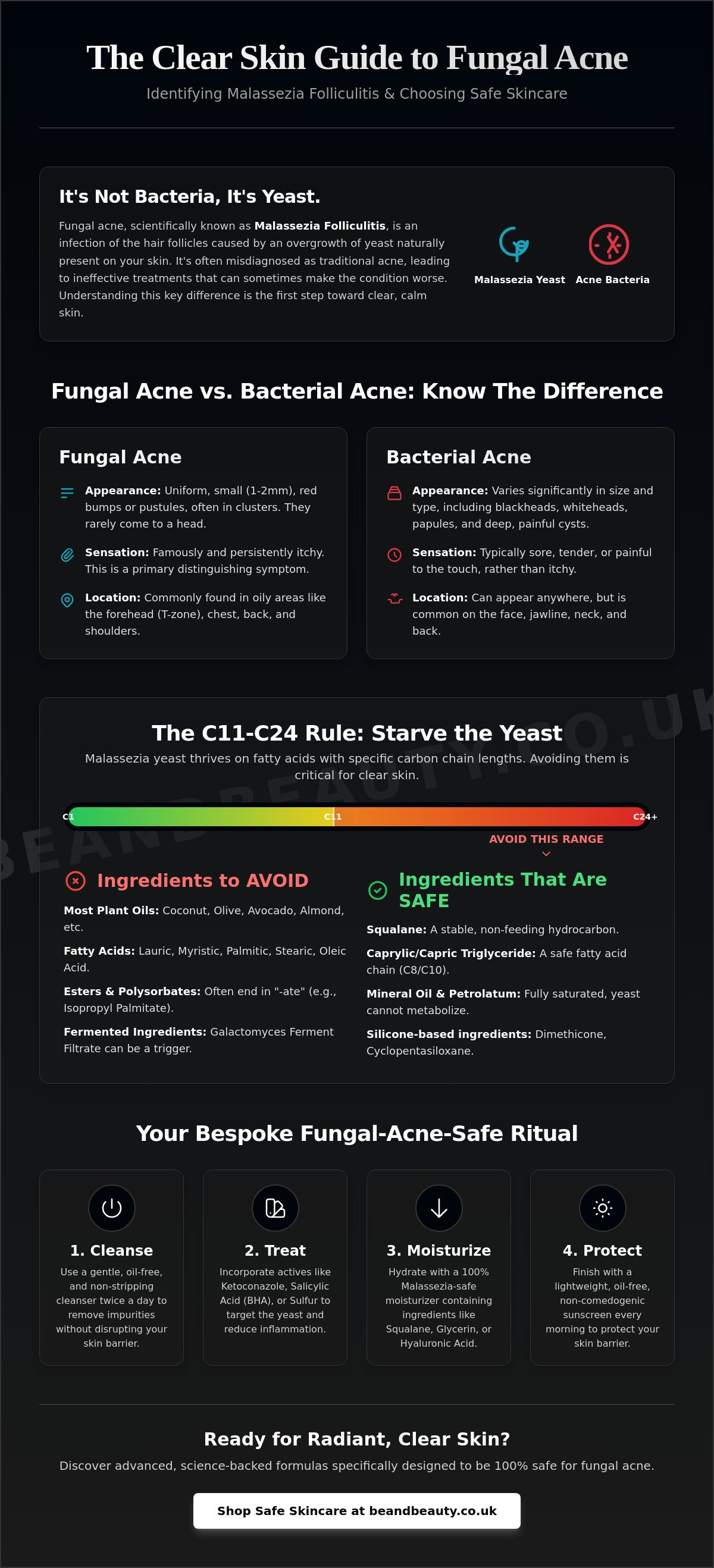
Unlike the varied lesions of hormonal breakouts, these bumps appear remarkably consistent in size and are often accompanied by a persistent, distracting itch. It's a unique sensation that signals your skin's microbiome is out of balance. Malassezia folliculitis is a lipophilic yeast condition that thrives on specific skin oils. To better understand this concept, watch this helpful video:
Fungal Acne vs. Bacterial Acne: The Key Differences
Recognising the visual cues is the first step toward your radiant transformation. While bacterial acne presents as a mix of blackheads, whiteheads, and deep cysts, fungal acne manifests as clusters of small, red domes. These lesions don't usually "come to a head" in the way you'd expect. Finding the right skincare for fungal acne uk means choosing products that respect this biological difference. Consider these distinct markers:
- Uniformity: Fungal bumps are almost identical in size, whereas bacterial acne lesions vary significantly.
- Sensation: Fungal acne is famously itchy, while bacterial acne is usually sore, tender, or painful.
- Response: Traditional "acne" creams containing heavy lipids can actually make fungal flares worse by providing more fuel for the yeast.
Why Your Current Skincare Might Be "Feeding" the Flare
The term "lipophilic" means that this yeast literally loves oil. It consumes fatty acids, specifically those with carbon chain lengths between 11 and 24. Many luxurious-feeling moisturisers contain coconut oil, olive oil, or esters that provide a feast for the yeast, causing it to proliferate rapidly. This creates a cycle where the more you try to hydrate your itchy skin, the more fuel you provide for the inflammation. This is why identifying 100% safe skincare for fungal acne uk is vital for long-term clarity.
When you apply these "forbidden" ingredients, you're inadvertently supporting a cycle of inflammation and yeast proliferation. This often leaves the skin feeling oily yet dehydrated and irritated at the same time. By choosing bespoke, oil-free formulas, you starve the yeast while still nourishing your delicate skin barrier. A tailored approach ensures you aren't sacrificing your skin's health in the pursuit of comfort, allowing your natural beauty to shine through without the interference of Malassezia.
The Forbidden Ingredients: What to Avoid in Your UK Routine
Building a truly effective routine for skincare for fungal acne uk begins with a clinical gaze at your current shelf. The Malassezia yeast is a discerning eater. It thrives on fatty acids with carbon chain lengths between 11 and 24. This "C11-C24" rule is the gold standard for anyone seeking lasting clarity. When you apply products containing these specific lipids, you aren't just moisturising your skin; you're providing a banquet for the yeast to proliferate. Even fermented ingredients like Galactomyces, often praised for their rejuvenating properties, can act as a significant trigger for many individuals.
Don't be swayed by "Organic" or "Natural" labels. These terms describe the source of an ingredient, not its biological interaction with your skin's microbiome. In fact, most natural oils, including coconut, olive, and avocado, fall squarely within the forbidden carbon chain range. Following UK clinical guidance on fungal acne is essential to avoid the cycle of inflammation. Identifying these offenders requires a bespoke level of attention to detail that transforms your daily ritual into a science-backed wellness journey.
Common Skincare Esters and Fatty Acids to Spot
To protect your skin's tranquility, you must learn to identify ingredients ending in "-ate." These are esters, combinations of an alcohol and a fatty acid, which the yeast can easily break down. Look out for Isopropyl Palmitate, Glyceryl Stearate, and Polysorbates (20, 40, 60, and 80). Specific pure fatty acids like Stearic, Oleic, and Linoleic acids are also problematic. The elegant exception to this rule is Caprylic/Capric Triglycerides, also known as MCT oil. Because it consists of C8 and C10 chains, it remains safe for those prone to fungal breakouts while providing essential nourishment. If you're feeling overwhelmed by complex lists, you can explore our curated collections for peace of mind.
The Myth of "Oil-Free" Labelling
A common misconception is that an "oil-free" label guarantees safety. Unfortunately, a product can be technically oil-free while still containing esters and polysorbates that feed Malassezia. This is why a bespoke approach to reading labels with clinical precision is so important. You must check every step of your routine, from your morning cleanser to your evening SPF. Since the UK's Cosmetic Products Regulations updated on 31 January 2025 to ban 64 harmful substances, the market is becoming safer, but the responsibility for yeast-safe choices still rests on informed selection. By choosing products with a minimalist, science-led ingredient list, you ensure your path to radiant skin remains clear and uninterrupted.
Choosing Your Bespoke Fungal-Acne-Safe Products
Your journey toward a clear complexion requires more than just avoiding triggers. It demands a curated selection of ingredients that actively support your skin's health. Choosing the right skincare for fungal acne uk isn't just about elimination; it's about intelligent curation. A sophisticated routine begins with a cleanser that respects your skin barrier. You should avoid harsh sulfates that strip natural moisture, as a compromised barrier often leads to further irritation. Instead, look for gentle surfactants that leave the skin feeling supple and calm. This creates a perfect skincare for acne prone skin foundation, allowing subsequent treatments to work effectively without causing distress.
According to the Primary Care Dermatology Society on Fungal Acne, topical management is the first line of defense. Since Malassezia thrives on oils, hydration must come from high-quality humectants. Hyaluronic acid and Glycerin are exceptional choices. They draw moisture into the skin without providing the lipids that yeast requires. To refine your texture, Salicylic acid (BHA) serves as a vital tool. It penetrates deep into the pores to clear the debris that can trap yeast, promoting a smoother and more radiant finish. This science-led approach ensures your skincare for fungal acne uk remains effective and luxurious.
The Power of Urea and Propolis
Urea acts as a powerful keratolytic agent. It helps disrupt fungal cell walls while simultaneously providing deep hydration. When you pair this with Propolis, which offers natural antimicrobial and soothing properties, your skin receives a protective layer of care. These ingredients work in harmony to rejuvenate inflamed areas and calm the "itchy" sensation common with Malassezia. This combination supports a radiant, healthy complexion without the risk of irritation, making it a cornerstone of any tailored wellness ritual.
Sun Protection for Fungal Acne
Sun protection remains a non-negotiable step in your daily routine. Finding an FA-safe formula in the UK can be challenging, as many traditional sunscreens rely on esters for their texture. You should focus on inorganic filters like Zinc Oxide or specific safe organic filters that don't feed the yeast. For a deeper understanding of sun safety, our spf 50 guide details the principles of advanced protection. By choosing a science-backed sunblock, you protect your progress and prevent post-inflammatory hyperpigmentation, ensuring your path to clarity is well-guarded.
Crafting a Radiant Ritual: A Step-by-Step UK Routine
The UK's unique climate, often characterized by high humidity and shifting temperatures, can exacerbate Malassezia overgrowth. Whether you're navigating the humid environment of a morning commute or dealing with damp coastal air, your routine must be resilient. A sophisticated approach to skincare for fungal acne uk focuses on preventative care and elegant restoration. This ritual is your daily invitation to pause and invest in your skin's long-term wellness through a journey of scientific precision.
- Morning Ritual: Begin with a gentle, pH-balanced cleanser to refresh the skin. Follow with a targeted serum containing humectants and finish with a bespoke, yeast-safe SPF 50 to protect against environmental stressors.
- Evening Ritual: If you use makeup, start with a safe micellar water. Follow with your primary cleanser and a humectant-rich moisturiser to replenish the skin barrier while you sleep.
- Weekly Treatment: Incorporate a specialized mask to rejuvenate skin texture. This deeper level of care helps clear lingering follicle debris and promotes a smoother, more radiant complexion.
Lifestyle choices play a significant role in maintaining clarity. In the UK, gym culture and active commutes mean sweat management is vital. Yeast thrives in warm, moist environments, so it's essential to cleanse your skin immediately after exercise. Additionally, changing your pillowcase every 2 days prevents the accumulation of lipids and yeast. These small, intentional shifts in your daily habits ensure your skincare for fungal acne uk delivers the best possible results.
Step 1: The Foundation of Purity
Maintaining the acid mantle is the first step toward tranquility. A cleanser with a pH of approximately 5.5 ensures your skin's natural defenses remain intact and hostile to yeast. Always use lukewarm water during your ritual. Hot water can trigger inflammation and compromise the delicate skin barrier you're working to protect. Use a gentle touch and avoid physical scrubs. Aggressive friction can cause micro-tears and spread yeast across the face, disrupting your path to a clear and calm reflection.
Step 2: Targeted Rejuvenation
This stage is where you introduce safe actives to address specific concerns. Azelaic acid serves as a multi-functional ally for both acne and redness. It effectively inhibits yeast growth while calming the skin's appearance, making it a cornerstone for those with sensitive complexions. Integrate humectants like hyaluronic acid to achieve that bespoke, dewy glow that reflects true health and vitality. To begin your transformation with professional-grade formulas, you can browse our dermatologist-approved collection designed for sensitive and acne-prone skin.
Discover Advanced Solutions: The Be & Beauty Collection
Achieving a clear complexion is a personal journey that requires more than just clinical utility; it demands a ritual that feels as good as it works. At Be & Beauty, we're committed to tailored wellness and natural-looking results that honour your skin's unique needs. Finding the right skincare for fungal acne uk often feels like a series of compromises, but our curated selection of European dermo-cosmetics offers a sophisticated alternative. We believe that professional-grade care should be a tranquil experience, providing you with the confidence that every ingredient is working in harmony with your microbiome.
The Novaclear Acne line represents a pinnacle of science-led skincare, offering dermatologically tested options that avoid the pitfalls of traditional acne treatments. For those seeking a deeper level of purification, the Novaclear Acne Mask serves as an essential weekly treatment. It's designed to clear lingering debris from the follicles while soothing the skin, ensuring your path to clarity is both effective and restorative. By integrating these advanced solutions into your routine, you're not just treating a condition; you're investing in a bespoke journey toward lasting skin health.
Novaclear Acne Cream: Clinical Precision
The Novaclear Acne Cream is crafted with clinical precision to address the complexities of Malassezia-prone skin. It effectively balances sebum production without the use of heavy, yeast-triggering oils that often lead to further congestion. The sensory experience is intentionally lightweight. Its elegant texture absorbs quickly, making it a perfect choice for daily wear under makeup or SPF. This cream provides the necessary hydration your skin craves while maintaining a matte, refined finish that highlights your natural radiance. It's a cornerstone for anyone building a science-backed ritual of skincare for fungal acne uk.
Novaclear Atopis: Comfort for Sensitive Skin
While some suggest using harsh anti-dandruff shampoos as a face wash, these can be incredibly drying and disrupt the acid mantle. The Novaclear Atopis Face & Body Wash offers a superior, gentler alternative for sensitive, fungal-prone skin. It cleanses deeply without stripping the moisture barrier, leaving your skin feeling calm and supple. For a deeper look at managing reactive complexions, you may find our atopic skin care guide helpful for restoring comfort. We invite you to begin your personalised journey to clarity today, knowing that your wellness is at the heart of everything we do.
Embrace Your Path to Radiant Skin
Reclaiming your skin's health is a deeply personal journey that requires both clinical precision and a gentle, caring touch. You've learned that managing Malassezia yeast isn't about harsh chemicals, but about a bespoke approach that starves the triggers while nourishing your unique barrier. By adhering to the "C11-C24" rule and choosing science-backed humectants, you're building a foundation of wellness that lasts. Selecting the right skincare for fungal acne uk is a transformative step toward self-confidence, ensuring your reflection finally matches how you feel inside.
At Be & Beauty, we're here to support you with dermatologically tested formulations and expert guidance tailored to the UK climate. Our bespoke skincare journeys are designed to make you feel seen and valued, providing the tranquility you deserve during your daily ritual. Whether you're just starting or refining a long-term routine, our UK-based expert support is always available to help you navigate your path. Explore our curated Novaclear Acne Collection for a radiant, clear complexion and take the first step toward the smooth, luminous skin you've been dreaming of. It's time to let your inner beauty shine through with clarity and grace.
Common Questions About Your Path to Clarity
Can I use Nizoral shampoo on my face for fungal acne?
Yes, you can use Nizoral shampoo as a short-contact mask to target the yeast overgrowth. It contains ketoconazole, an antifungal agent that the Primary Care Dermatology Society recommends for managing Malassezia. In the UK, a 60ml bottle typically costs between £5.81 and £8.50 at major retailers. Apply it to damp skin for 5 minutes before rinsing, but be mindful that the sulfates can be drying for sensitive complexions.
Is hyaluronic acid safe for fungal acne?
Hyaluronic acid is entirely safe and highly recommended for anyone navigating skincare for fungal acne uk. It's a pure humectant that draws moisture into the skin without providing the fatty acids that yeast requires to thrive. This allows you to maintain a radiant, dewy glow while ensuring your treatment remains effective and focused on long-term wellness.
How long does it take for fungal acne to clear with the right skincare?
You'll likely notice a significant reduction in itchiness within 24 to 48 hours of starting a safe ritual. The physical bumps typically begin to flatten and disappear over a period of 4 to 8 weeks. Consistency is essential during this time to ensure the yeast population remains balanced and doesn't trigger a new inflammatory cycle.
Why is my fungal acne itchy?
The itchiness is a direct result of Malassezia yeast breaking down your skin's sebum into irritating free fatty acids. This process triggers an inflammatory response within the hair follicle, leading to that distinct, distracting sensation. It's a clear signal from your skin that the microbiome is out of balance and requires a more bespoke, oil-free approach to care.
Are there any oils that are safe for fungal acne?
Most natural oils are forbidden, but 100% Squalane oil and MCT oil (Caprylic/Capric Triglycerides) are the elegant exceptions. These specific lipids don't contain the carbon chain lengths that fuel yeast growth. They provide a luxurious way to nourish your skin and prevent dehydration without compromising the clarity of your complexion.
What happens if I use regular acne cream on fungal acne?
Using regular acne creams can often make the condition worse if they contain esters, polysorbates, or fatty acids. While the active ingredients might target bacteria, the cream's base can inadvertently "feed" the yeast. This is why many individuals find their skin becomes more inflamed when using traditional high-street treatments that aren't specifically formulated for fungal concerns.
Can sweat cause fungal acne flares in the UK summer?
High humidity and sweat are major triggers for fungal flares during the UK summer months. The combination of heat and moisture creates an ideal environment for yeast to proliferate rapidly across the forehead, chest, and back. We recommend cleansing your skin immediately after exercise or a humid commute to maintain a calm and clear complexion.
Is niacinamide good for fungal acne?
Niacinamide is an excellent ally for maintaining a clear and balanced complexion. It helps regulate sebum production, which reduces the "food" available for the yeast, and strengthens the skin's natural barrier. Integrating this active into your routine supports a refined texture and helps soothe the redness often associated with fungal irritation.


